

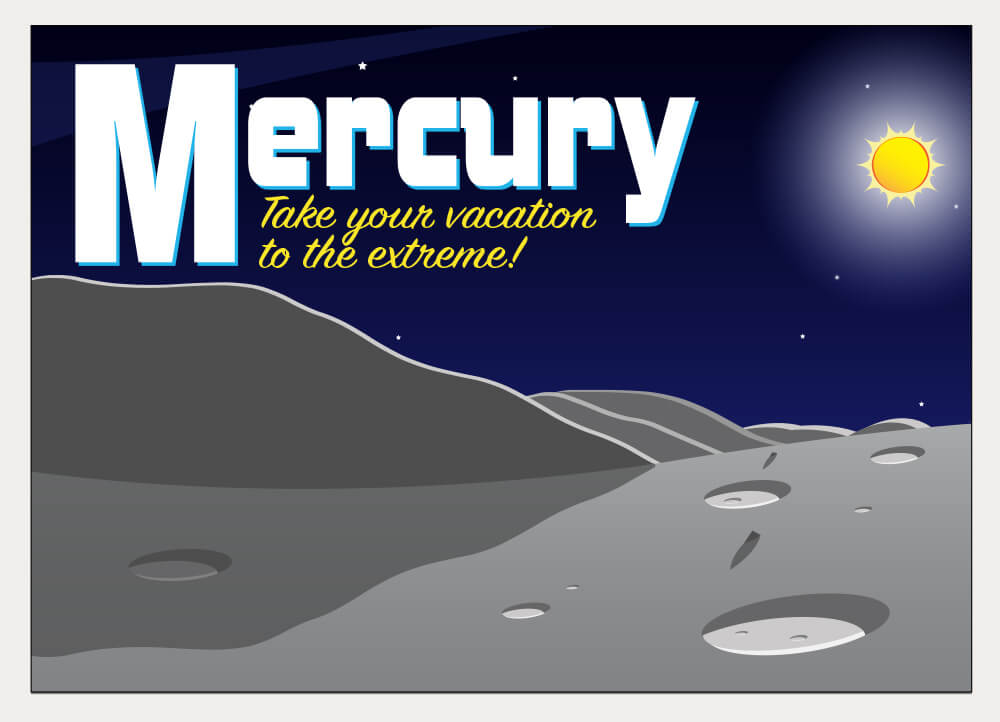
Any vacation on Mercury would be ruined by extreme temperatures. During the daytime, the Sun would appear three times larger and about seven times brighter than it does here on Earth. During the day, temperatures would be as high as 800 degrees F, and at night temperatures could sink to -300 degrees F. Brr! Credit: NASA/JPL-Caltech
Mercury is the smallest planet in our solar system. It’s just a little bigger than Earth’s Moon. Mercury itself, though, doesn’t have any moons. It is the closest planet to the Sun, but it’s actually not the hottest. Venus is hotter.
Along with Venus, Earth, and Mars, Mercury is one of the rocky planets. It has a solid surface that is covered with craters. Instead of an atmosphere, Mercury possesses a thin exosphere made up of atoms blasted off the surface by the solar wind and striking meteoroids. Mercury’s exosphere contains sodium, potassium, calcium, magnesium, hydrogen, helium, and other elements.
Explore Mercury! Click and drag to rotate the planet. Scroll or pinch to zoom in and out. Credit: NASA Visualization Technology Applications and Development (VTAD)
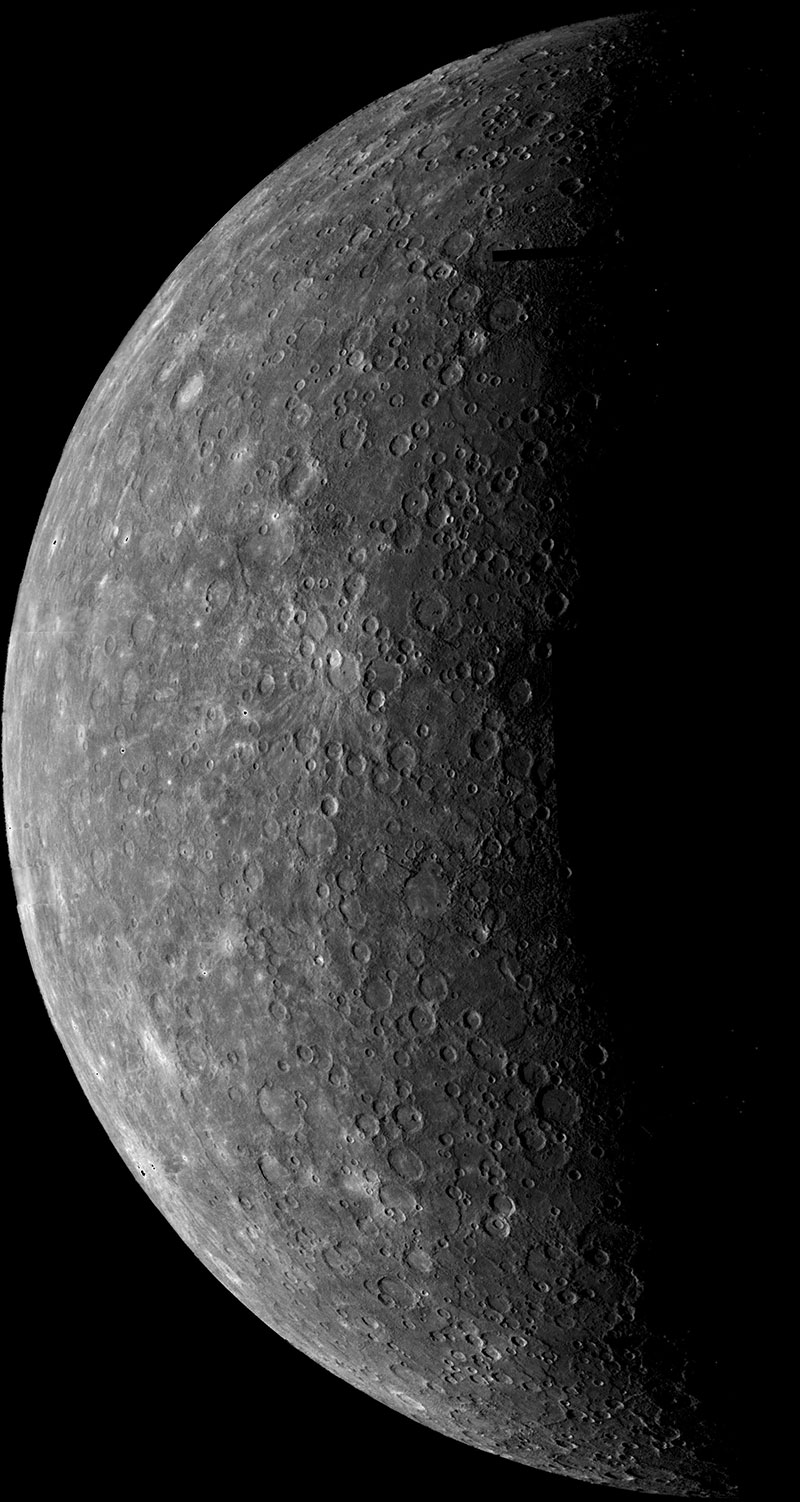
Mariner 10's first image of Mercury taken on March 24, 1974. Credit: NASA/JPL/USGS
Mercury spins much more slowly than Earth. It takes 59 Earth days for Mercury to spin around once. But because Mercury is the closest planet to the Sun, it doesn’t take long to go all the way around it. A year on Mercury is only 88 Earth days long. If you lived on Mercury, you’d have a birthday about every three months.
What’s more, Mercury’s spin and orbit are in a special arrangement that means there are only three Mercury days every two Mercury years. On Earth we have a sunrise every 24 hours. On Mercury, you would only see one sunrise every 176 Earth days. Isn’t that wild?
Credit: NASA/JPL-Caltech
Structure and Surface
- Mercury is the smallest planet in our solar system.
- Mercury is a terrestrial planet. It is small and rocky.
- Mercury has a thin exosphere.
- Mercury’s surface can be as hot as 800 degrees F during the daytime and as cold as -300 degrees F during the nighttime. (But Mercury is not the hottest planet in the solar system. The hottest planet is Venus.)
- Mercury’s poles have water-ice.
Time on Mercury
- A day on Mercury lasts 59 Earth days.
- A year on Mercury lasts 88 Earth days.
Mercury’s Neighbors
- Mercury does not have any moons.
- Mercury is the closest planet to the Sun.
- Venus is Mercury’s neighboring planet.
Quick History
- Mercury has been known since ancient times because it can be seen without advanced telescopes.
- Because it is so close to the Sun, Mercury is hard to study from Earth. No people have ever gone to Mercury, but two robotic spacecraft have visited. The spacecraft were called Mariner 10 and MESSENGER.
- MESSENGER mapped Mercury by taking pictures of the planet's surface, including some areas that had not been seen before. It also collected information about what the surface and insides of Mercury are made of.
What does Mercury look like?
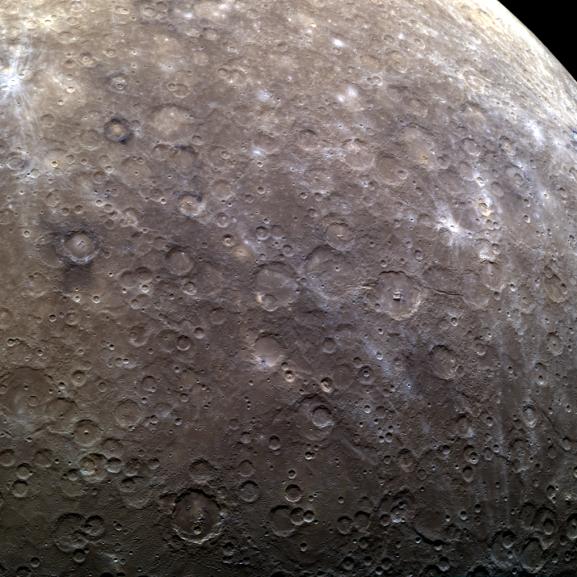
This image shows a beautiful view of Mercury's cratered southern hemisphere. Credit: NASA/Johns Hopkins University Applied Physics Laboratory/Carnegie Institution of Washington
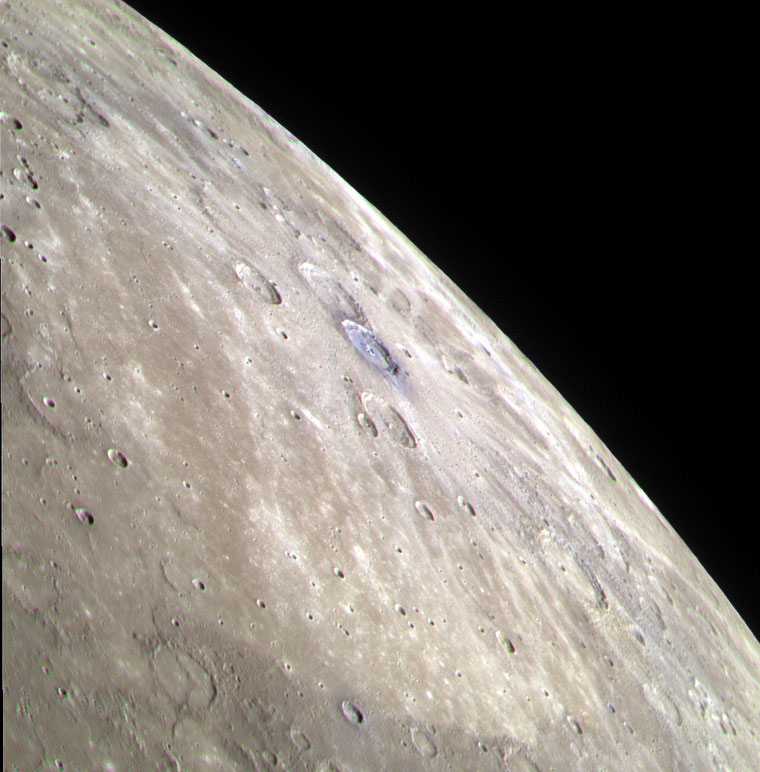
The many craters of Mercury. Credit: NASA/Johns Hopkins University Applied Physics Laboratory/Carnegie Institution of Washington
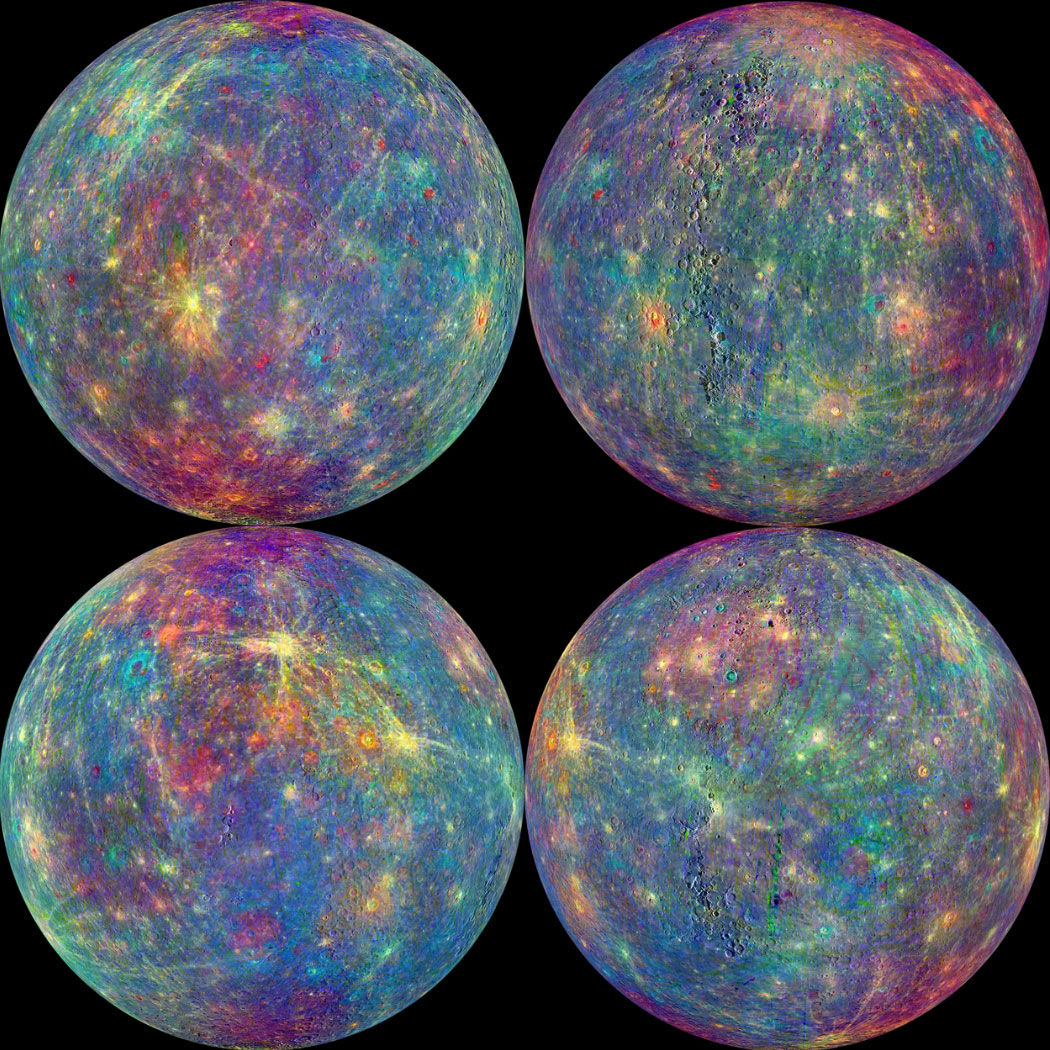
The MESSENGER spacecraft was the first ever to orbit the planet Mercury, and the spacecraft's seven scientific instruments, like the MASCS instrument, were used to create this colorful illustration of Mercury’s surface and helped scientists unravel the history and evolution of the innermost planet. Credit: NASA/Johns Hopkins University Applied Physics Laboratory/Carnegie Institution of Washington
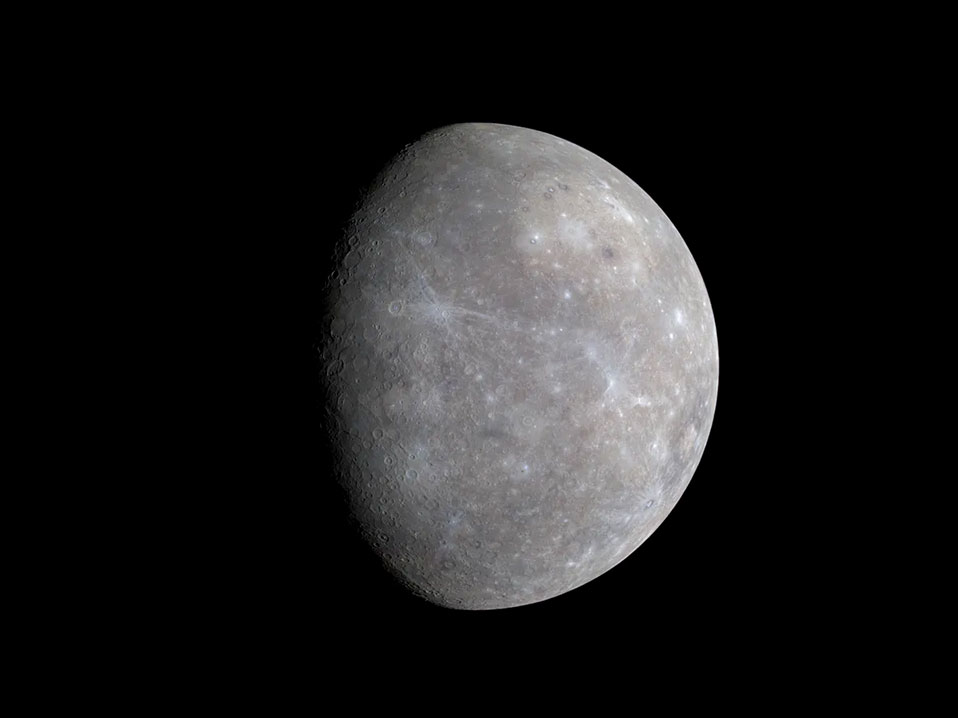
Color differences on Mercury may be hard to see, but they reveal important information about the planet's surface material. A number of bright spots with a bluish tinge are visible in this image. These are relatively recent impact craters. Credit: NASA/Johns Hopkins University Applied Physics Laboratory/Carnegie Institution of Washington